

A changing European landscape for women’s health
Women’s health is gaining increasing attention across European health policy, cardiovascular prevention and regulatory science. In September 2026, three developments in particular highlighted this shift. On 16 September, the European Parliament adopted an own-initiative report on gender inequalities in health, specifically as regards gender-specific conditions, bringing the women’s health gap further into the European policy debate. On the same day, the Parliament also adopted its position on an EU cardiovascular diseases strategy, reinforcing the political momentum around cardiovascular prevention that followed the European Commission’s Safe Hearts Plan.
At the same time, the European Medicines Agency (EMA) has strengthened its work on Women’s health, with a dedicated initiative addressing evidence gaps, women’s representation in clinical research, real-world data and sex-related differences in health and treatment. EMA will also bring regulators, patients, healthcare professionals, researchers, industry and international partners together for a dedicated Multistakeholder workshop on women’s health on 28–29 September.
These developments are different in nature: the European Parliament reports establish political positions rather than binding legislation, while EMA’s activities concern regulatory science and the evidence base supporting medicines development and assessment. Taken together, they show that women’s health is becoming a more visible priority across research, regulation and prevention, areas that are central to CARAMEL.
CARAMEL will also be directly connected to this evolving European conversation. On 1 October, Project Coordinator Iván Macía will attend the high-level event From Challenges to Action: Scaling Women’s Health Innovation in Europe at the European Parliament in Brussels. Jointly organised by the European Parliament and the European Innovation Council and SMEs Executive Agency (EISMEA), the event will bring together policymakers, innovators and investors to identify priorities and actionable solutions for strengthening Europe’s women’s health innovation ecosystem. Iván has been invited to attend in connection with CARAMEL, offering the project a valuable opportunity to follow these discussions first-hand and strengthen its links with the wider European women’s health innovation community.
From the women’s health gap to women-specific evidence
Many of the priorities now moving higher on the European agenda have been embedded in CARAMEL from the outset. The project focuses specifically on cardiovascular prevention in women aged 40–60 during the menopausal transition, bringing together multimodal health data, AI, clinical research and women’s lived experiences to improve cardiovascular risk assessment and personalised prevention. This women-centred approach also reflects the growing attention to representative and inclusive insights. Through the CARAMEL-WOMEN study, Patient and Public Involvement (PPI) activities and co-creation, women and healthcare professionals are actively shaping the project’s research and digital solutions, with specific attention also given to women with intellectual disabilities.
CARAMEL evidence is already reaching the European cardiovascular community. At ESC Congress 2026 in Munich in August, the Trinity College Dublin team presented a Poster on “Knowledge Gaps in Cardiovascular Health among (Peri)menopausal Women”. Based on responses from 7,470 women involved in CARAMEL-WOMEN, the findings highlighted remaining misconceptions around women’s cardiovascular risk and the need to strengthen cardiovascular education and timely healthcare-seeking during the menopausal transition.
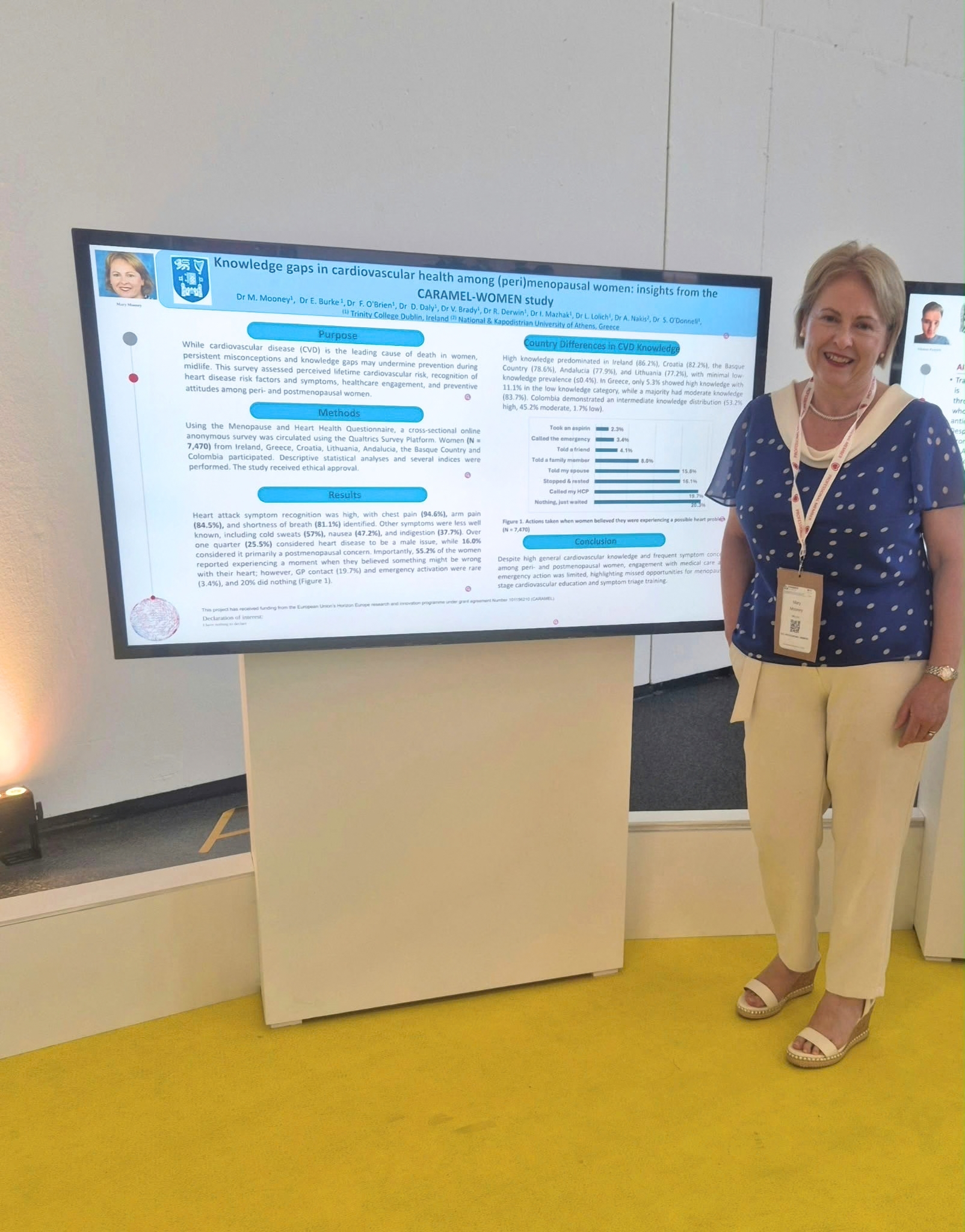
Prof. Mary Mooney (TCD) at ESC Congress 2026 in Munich
Cardiovascular prevention: building on the Safe Hearts Plan
The European Parliament’s position on a cardiovascular diseases strategy adds further momentum to an agenda already advanced by the European Commission’s Safe Hearts Plan, with its focus on prevention, early detection, personalised care, digital innovation and health inequalities.
As we explored in our previous article, The EU Safe Hearts Plan and CARAMEL: aligning European ambition with real-world prevention for women, these priorities strongly intersect with CARAMEL’s work. The project is already generating women-specific evidence and developing AI-supported tools to support earlier and more personalised cardiovascular prevention during menopause. These developments also create new opportunities for CARAMEL’s findings to inform European discussions on cardiovascular prevention during menopause.
This dialogue will continue later this year: on 25 November, Iván Macía will represent CARAMEL as a panellist in a roundtable at a HaDEA event dedicated to the Safe Hearts Plan, providing a further opportunity to bring the project’s perspective into the European cardiovascular prevention debate.
The role of the Menopause and Heart portal
Better information and recommendations also need to reach the women and healthcare professionals who can use it.
Menopause and Heart, the CARAMEL CVD Prevention Portal, translates research evidence and co-creation findings into accessible, scientifically grounded information on menopause and cardiovascular health. Its menopause-first approach reflects what women told the project: menopause is often the entry point through which they begin asking questions about their heart health. By connecting awareness, health literacy and prevention, the Portal puts into practice another priority increasingly visible at European level: turning knowledge into informed and actionable health choices. Learn more about the development of the Menopause and Heart Portal and the co-creation process behind it on the dedicated page.
From research to policy impact: the future of CARAMEL
As women-specific evidence and personalised cardiovascular prevention gain greater prominence in Europe, CARAMEL is preparing to bring its findings beyond the research setting. Insights from the project’s clinical research and co-creation activities will inform outputs for healthcare and policy audiences, including a CARAMEL Policy Brief. These outputs will help communicate the implications of the project’s results and support their uptake in the evolving European approach to cardiovascular prevention and women’s health.
Follow CARAMEL on LinkedIn to keep up with the project’s progress and upcoming outputs.